Choosing & specifying
Kitchen carcasses: chipboard, MDF and Malta's humidity
The box behind the door is where a kitchen either survives a humid island or quietly swells at the edges. Here is what the board grades mean, what one German maker actually publishes, and what to ask a Malta or Sicily showroom.
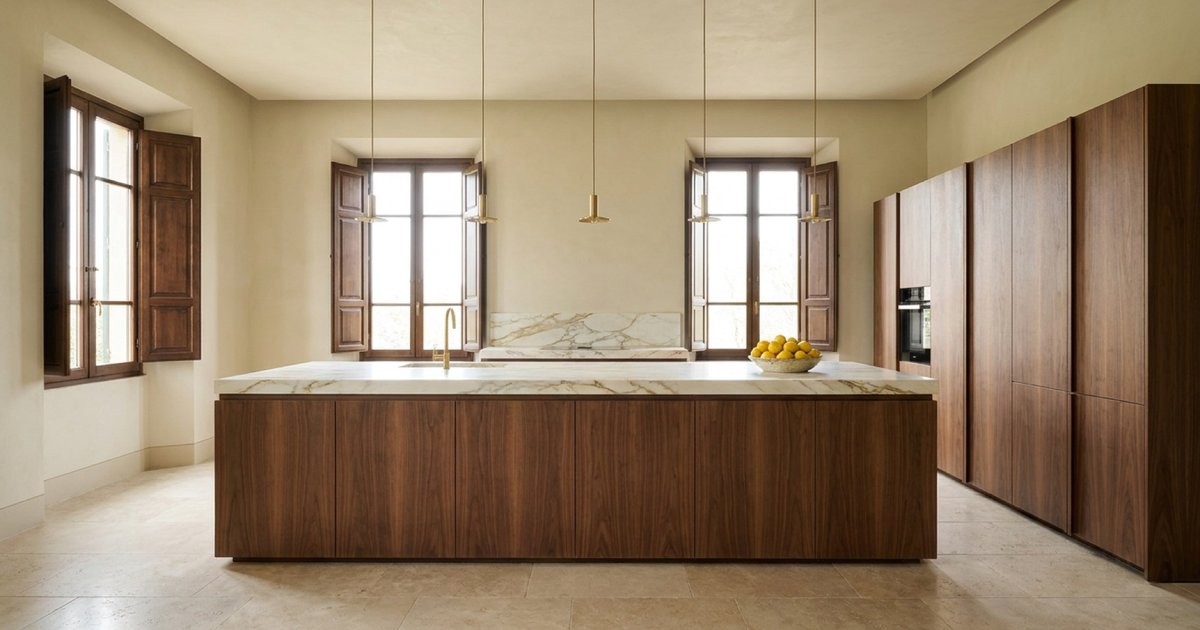
Most kitchen buying decisions happen at the door. You choose a finish, a handle, a worktop. The carcass — the box the door is screwed to — is the part nobody shows you and the part that decides whether the kitchen still closes properly in eight years. In a humid coastal flat, often with a shower room sharing a wall and windows that stay open from April to October, that box is doing more work than it would in Surrey.
This article covers what the boxes are made of, what the European board grades actually mean, and what you can reasonably ask a showroom to put in writing.
What a carcass is made of
Almost every mass-produced European kitchen uses coated particleboard (chipboard) for the sides, base, top and shelves, with a thin hardboard or MDF back panel. Solid wood carcasses are rare and are not what a showroom means when it says "German" or "Italian" quality. The quality differences live in the board grade, the coating, the edging and how the parts are joined.
That is also why "it's all the same chipboard" is wrong. Particleboard is a family of graded products under EN 312, and the grades are not interchangeable.
EN 312: what P3 and P5 mean
Kronospan, a board manufacturer, publishes definitions for the two grades you are most likely to encounter in kitchen and bathroom furniture:
| Grade | Standard | Kronospan's definition |
|---|---|---|
| P3 | EN 312 type P3 | Non-load-bearing board for dry and humid conditions |
| P5 | EN 312 type P5 | Load-bearing board for dry and humid conditions |
Both are listed by the maker for kitchen and bathroom furniture. The distinguishing word is load-bearing: P5 is rated to carry structural load, P3 is not. Both are specified for humid as well as dry conditions, so a higher number does not automatically mean "more waterproof" — it means a different structural duty.
Kronospan describes its P3 as having low swelling in thickness and increased resistance to humid conditions, available in 12 to 38 mm, fire class D-s2, d0 under EN 13501-1, and emission class E1 under EN ISO 12460-5. Its listed uses include bathroom and kitchen furniture and kitchen doors. No numeric swelling limit is published on that page, so treat "low swelling" as the manufacturer's wording rather than a measurable promise.
The honest reading for Malta: a board rated for humid conditions is designed for humid air. It is not designed for a leaking waste trap under a sink, or for a floor-standing base unit sitting in water after a washing machine hose lets go. Nothing in these specifications says otherwise.
Moisture-resistant MDF is a conditional rating
MDF turns up in kitchens as back panels, plinths and painted doors. Kronospan classes its moisture-resistant MDF under EN 622-5 as type MDF.HLS: a board for use in humid conditions under instantaneous or short-term load only. That qualifier is the whole point. The maker positions it for moisture-prone areas, not as a waterproof material. It is offered in 10, 16, 18, 19 and 22 mm, with a fine homogeneous surface suited to painting, laminating, veneering and foiling, and emission class E1 under EN ISO 12460-5.
So if a showroom tells you a painted MDF door or an MDF plinth is "fine for Malta because it's moisture resistant", that is half true. It is rated for humid conditions. It is not rated for sustained wetting.
A worked example: nobilia's published carcase spec
nobilia is a German manufacturer whose technical product description (released 08.01.2026) is published openly. Oxford House in Malta states on its kitchens page that it is a proud agent of nobilia and Bosch, offers design consultations and appointments, and has nobilia 2026 catalogues and a range of worktop thicknesses and materials. That page gives no carcass specification of its own, so the maker's document is the thing to read.
What nobilia publishes:
- Carcase sides and construction shelves: 16 mm or 19 mm chipboard with direct melamine-resin coating, white inside as standard.
- Edging: base and tall units get PP edging on the front edge, with paper edging top, bottom and rear. Wall units get PP on the front edge, thin PP top and bottom, paper at the rear.
- Loose shelves: 16 mm chipboard, maximum recommended load 50 kg/m2.
- Back panel: 2.8 mm hard fibreboard (HDF/MDF), grooved 4–6 mm into the sides.
- Joints: sides and shelves glued with 8 × 30 mm hardwood dowels.
- Plinth: 13 mm MDF with a sealing profile, or a water-resistant plastic hollow-chamber plinth as an option.
- Laminate worktops: PP edges glued with waterproof PUR adhesive; cut-outs must be sealed on site with a moisture-repelling agent.
Two things are worth drawing out. First, the document does not state an EN 312 P-grade and does not state an emission class for the carcase board. Anyone who tells you a nobilia box is P3, P2 or P5 is going beyond the published spec. Ask for it in writing if it matters to you.
Second, look at the plinth and worktop lines. The maker itself flags the two places water actually gets in: the plinth at floor level, and the cut-outs for sink and hob. A water-resistant plastic hollow-chamber plinth exists as an option precisely because a 13 mm MDF plinth sitting on a wet floor is the weak point. And the instruction that cut-outs must be sealed on site with a moisture-repelling agent is an instruction to your fitter, not to the factory. If the fitter skips it, the worktop fails from the inside out and the factory warranty will not help you.
Edging and sealing matter more than the grade
Notice that in nobilia's spec, the durable PP edging goes on the front edge — the one you see and touch — while the top, bottom and rear edges of base and tall units get paper edging. That is a normal construction decision, not a defect. But it means the protected faces of a carcass are the coated ones, and the vulnerable ones are the cut edges hidden against the wall and the floor.
In practice, in a Maltese kitchen, that argues for:
- Making sure plinths and any gap at floor level are sealed, and considering the water-resistant plinth option where it is offered.
- Making sure sink and hob cut-outs are sealed on site, and asking who is contractually responsible for doing it.
- Treating under-sink units as the highest-risk cabinet in the room, regardless of board grade.
Formaldehyde: E1 is no longer the benchmark
Board products are bonded with resins that emit formaldehyde. The long-standing European class was E1, which the Fraunhofer WKI puts at 0.124 mg/m3 — that is 0.1 ppm — measured by the EN 717-1 chamber method. Kronospan's P3 and moisture-resistant MDF pages both cite E1, declared under EN ISO 12460-5.
That benchmark has been overtaken. Commission Regulation (EU) 2023/1464 added a formaldehyde restriction to REACH Annex XVII. From 6 August 2026, furniture and wood-based materials must not release more than 0.062 mg/m3 — half the old E1 figure. Other articles are capped at 0.080 mg/m3, and road-vehicle interiors follow from 6 August 2027. EN 717-1 and EN 16516 are the referenced test methods.
Malta is in the EU, so this applies to furniture placed on the Maltese market. Sicily is in the EU too, so a kitchen bought in Pozzallo or Catania is under the same restriction. The practical consequence is that "E1" on a product sheet is now a statement about an older, more permissive class, not proof of compliance with the current limit. If a showroom quotes E1 at you, the follow-up question is whether the product meets the 0.062 mg/m3 figure.
Questions to put to a showroom
Written answers, not verbal ones:
- What is the carcass board — thickness, coating, and EN 312 grade if the manufacturer declares one?
- Does the manufacturer declare compliance with the 0.062 mg/m3 formaldehyde limit for furniture, and under which test method?
- What edging is used on the front edge, and what is used top, bottom and rear?
- What is the back panel, and is it grooved into the sides or pinned on?
- Is a water-resistant plinth option available, and what is the plinth made of as standard?
- Who seals the worktop cut-outs on site, and is that in the quoted price?
- What is the maximum recommended shelf load? (nobilia publishes 50 kg/m2 for its 16 mm loose shelves — a useful yardstick when someone else won't give you a number.)
The Malta and Sicily angle
Two structural facts about this market are worth holding on to. Most showrooms here publish no brand list at all, so you often cannot tell from a website whose carcasses you are being sold — Oxford House naming nobilia and Bosch is the exception rather than the rule. And Sicily is a ferry ride away, frequently cheaper for the same Italian brands. Within the EU, VAT is paid once in the country of purchase, so buying in Sicily does not generate a second Maltese VAT bill — but it does generate a shipping and fitting problem that you, not the showroom, will usually own. If the kitchen is going to Gozo, add a ferry to every delivery and every return of a damaged panel.
None of that changes the board science. It changes who is standing in your kitchen when a panel arrives with a chipped edge, and how long it takes to replace.
Common questions
- What is the difference between EN 312 P3 and P5 particleboard?
- Kronospan defines P3 as a non-load-bearing board for dry and humid conditions, and P5 as a load-bearing board for dry and humid conditions. Both are EN 312 types and both are listed by the maker for kitchen and bathroom furniture. The difference is structural duty, not simply moisture performance — both are specified for humid conditions.
- Is moisture-resistant MDF waterproof?
- No. Kronospan classes its moisture-resistant MDF under EN 622-5 as type MDF.HLS, which is a board for use in humid conditions under instantaneous or short-term load only. It is positioned for moisture-prone areas, not as a waterproof material. The same caution applies to P3 particleboard: resistance to humid air is not the same as surviving standing water.
- What is the EU formaldehyde limit for kitchen furniture now?
- Commission Regulation (EU) 2023/1464 added a formaldehyde restriction to REACH Annex XVII. From 6 August 2026, furniture and wood-based materials must not release more than 0.062 mg/m3; other articles are limited to 0.080 mg/m3, and road-vehicle interiors follow from 6 August 2027. The older E1 class was 0.124 mg/m3, or 0.1 ppm, by the EN 717-1 chamber method — so the new furniture limit is half the old E1 figure.
- Does nobilia say what grade of chipboard it uses?
- No. nobilia's published technical product description specifies carcase sides and construction shelves as 16 mm or 19 mm chipboard with a direct melamine-resin coating, but the document does not state an EN 312 P-grade or an emission class. If you want that confirmed, it has to come from the showroom in writing.
What we could not establish
- No Malta humidity figure is established by these sources, so none is quoted here. If you want a number for your own specification, it is not in the published kitchen literature.
- nobilia's technical product description does not state an EN 312 P-grade or a formaldehyde emission class for its carcase board. Any claim that a particular nobilia carcass is P2, P3 or P5 is not supported by the maker's own document.
- Oxford House's kitchens page states it is agent for nobilia and Bosch but gives no carcass specification, no lead times and no prices. No other Malta showroom's carcass spec was available to check.
- Plywood carcasses are not covered — no source on plywood was consulted for this article.
- No numeric thickness-swelling limits are given, because none of the sources state them. 'Low swelling in thickness' is Kronospan's wording for P3, not a measured figure.
- Nothing in these sources shows how Maltese or Sicilian showrooms verify compliance with the 6 August 2026 formaldehyde limit, or what documentation they hold.
Sources
- Technical product descriptions (carcase section) — nobilia · read 2026-10-05
- Particleboard P3 — Kronospan · read 2026-10-05
- Moisture Resistant MDF — Kronospan · read 2026-10-05
- Certification according to REACH (formaldehyde) — Fraunhofer WKI · read 2026-10-05
- Kitchens — Oxford House (Malta) · read 2026-10-05
Ready to price it?
One upload goes to every showroom that stocks what you are after, in Malta and Sicily.
Get quotes